Hi Marilyn…replace this with your intro 🙂
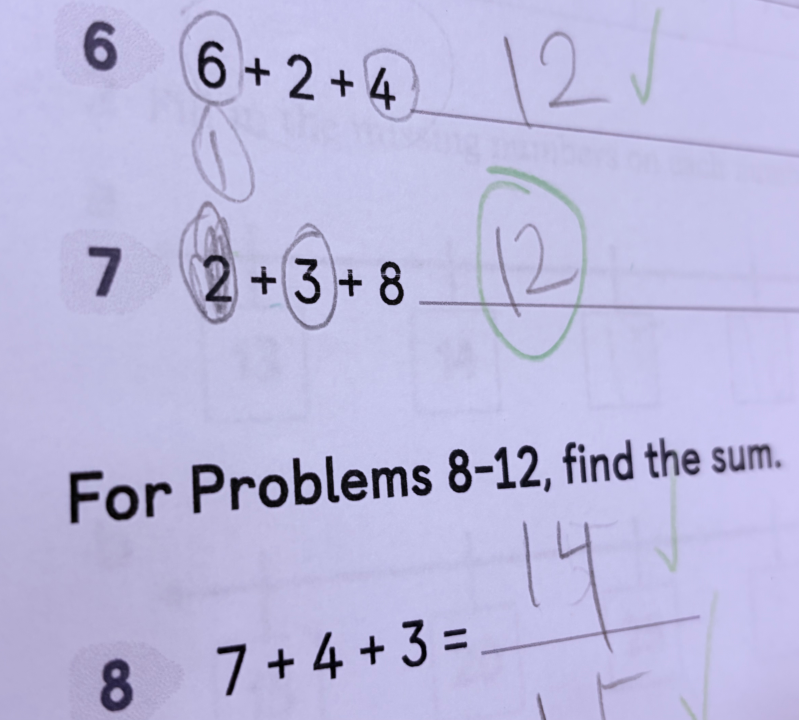
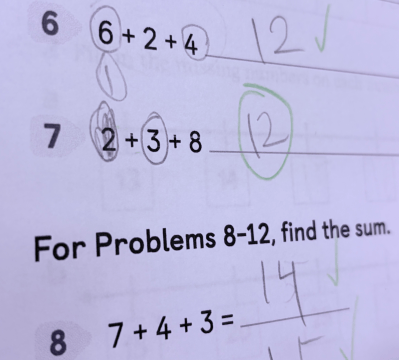
I sat down next to first grader Grace as she worked on a few subtraction problems. She was holding her pencil carefully — duck grip — with eyes tightly focused on her paper. I peered over her shoulder to view her written work, in blue:
9 – 6 = 3
7 – 3 = 4
5 – 2 = 3
8 – 3 = 4
8 – 5 = 2
7 – 5 = 1
Her first three answers were right. Her last three were each off by exactly one. Grace was working on transitioning to more sophisticated strategies, moving from counting on and counting back toward using derived facts and inverse operations, and that off-by-one pattern suggested that she was not fully comfortable with her new thinking. Was she counting back still? Had she misremembered a related addition fact? It wasn’t clear.
It’s always best to ask students what they were thinking, especially in moments like this, when the errors could have been the result of a dozen different things. Errors are a natural part of the process of taking on new ways of thinking, and understanding the reasoning behind them can help us move students forward.
Conferring with Grace
I asked Grace to tell me more about the first one.
9 – 6 = 3
“Nine minus six is three. Three plus six is nine,” Grace said crisply, then offered me a wry smile and a scrunched nose. For all her seriousness while she worked, that smile betrayed her impish delight. She enjoyed being right — and she knew she was.
“And the next one?”
7 – 3 = 4
She described the same process, using addition to check her subtraction, cocking her head confidently as she spoke.
“And the next?”
5 – 2 = 3
With each explanation, she grew more satisfied, sitting up a little straighter. She spoke quickly. Easily. Decisively.
“And the next?”
An Error
8 – 3 = 4
“Eight minus three is four. Four plus three equals seven.”
“Huh.” I paused, slowing the conversation, perhaps to a halt. “I thought you said that four plus three equals seven.”
Grace bristled. “Okay.”
“And I agree,” I said. “Three plus three is six, so three plus four is seven. Not eight.” I circled the four. “So eight minus three isn’t four.” Grace tugged at her sleeves while I recorded 3 + 3 = 6 and 3 + 4 = 7 in the margin of her paper. “Hey! It’s not a big deal! We can fix this. Let’s fix it together.”
My invitation to make corrections together didn’t soften the blow of being wrong. Grace averted her eyes.
I waited a beat.
Grace took the colored pencil I was using out of my hand. Was that the hint of a grin? I watched as she moved the tip of the pencil over the erroneous 4… and then… kept going. She went all the way to the 8, and crossed it out.
8 7 – 3 = 4
“Well, that worked!” I laughed. I think Grace knew that this wasn’t exactly what I had intended, but that she had also solved the problem — her problem, rather.
A New Pattern
We continued.
8 – 5 = 2
“And eight minus five isn’t two…” If she hadn’t rewritten the previous problem, I would have attempted to connect to a fact family. We can use 8 – 3 = 5 to solve 8 – 5, but, alas, 7 – 3 was less immediately helpful.
Grace bounced slightly in her seat and snuck a sideways glance at me before writing:
8 7 – 5 = 2
Once again she’d been off by one, and once again she fixed it by making the first number one smaller. She did the same thing for the last problem:
7 6 – 5 = 1
“Seven minus five is two, so six minus five is one,” Grace told me. She was consistently using derived facts, using one problem to solve another rather than starting from scratch with each calculation. This represented a huge shift from her kindergarten thinking, and a significant amount of progress so far this year.
Right Answer, Wrong Problem
Marilyn Burns often shares the following quote from her undergrad advisor:
“A student’s wrong answer is most often the right answer to a different but related question.”
– Bob Davis
I see this all the time: a fourth grader trying to calculate the area of a rectangle instead determines the perimeter. An eighth grader evaluates 85 as 8 • 5 . I had seen Grace’s 8 – 3 = 4 as simply wrong, but the difference of 4 was exactly right for the revised 7 – 3 .
Grace’s revisions revealed more about her thinking than correct answers would have. She wasn’t guessing. She wasn’t counting back. She was using the inverse relationship between addition and subtraction, and she made some errors in her fact recall. Her strategy is great and entirely appropriate for a first grade student, and the missing piece seems to be helping her to self-check calculations.
Vivienne’s Triangle
Earlier in the day, sixth grader Vivienne had shared her thinking on how to find the area of a triangle. This was our first lesson exploring the area of triangles, and she had devised her own strategy: inscribe the triangle in a rectangle, and then look for right triangles. Drawing a line straight down from the apex of the triangle decomposed it into two right triangles, and then she could find the area of each as ½ of the rectangular area. Rectangles are so nice and simple to work with!
4 • 5 + 2 = 22
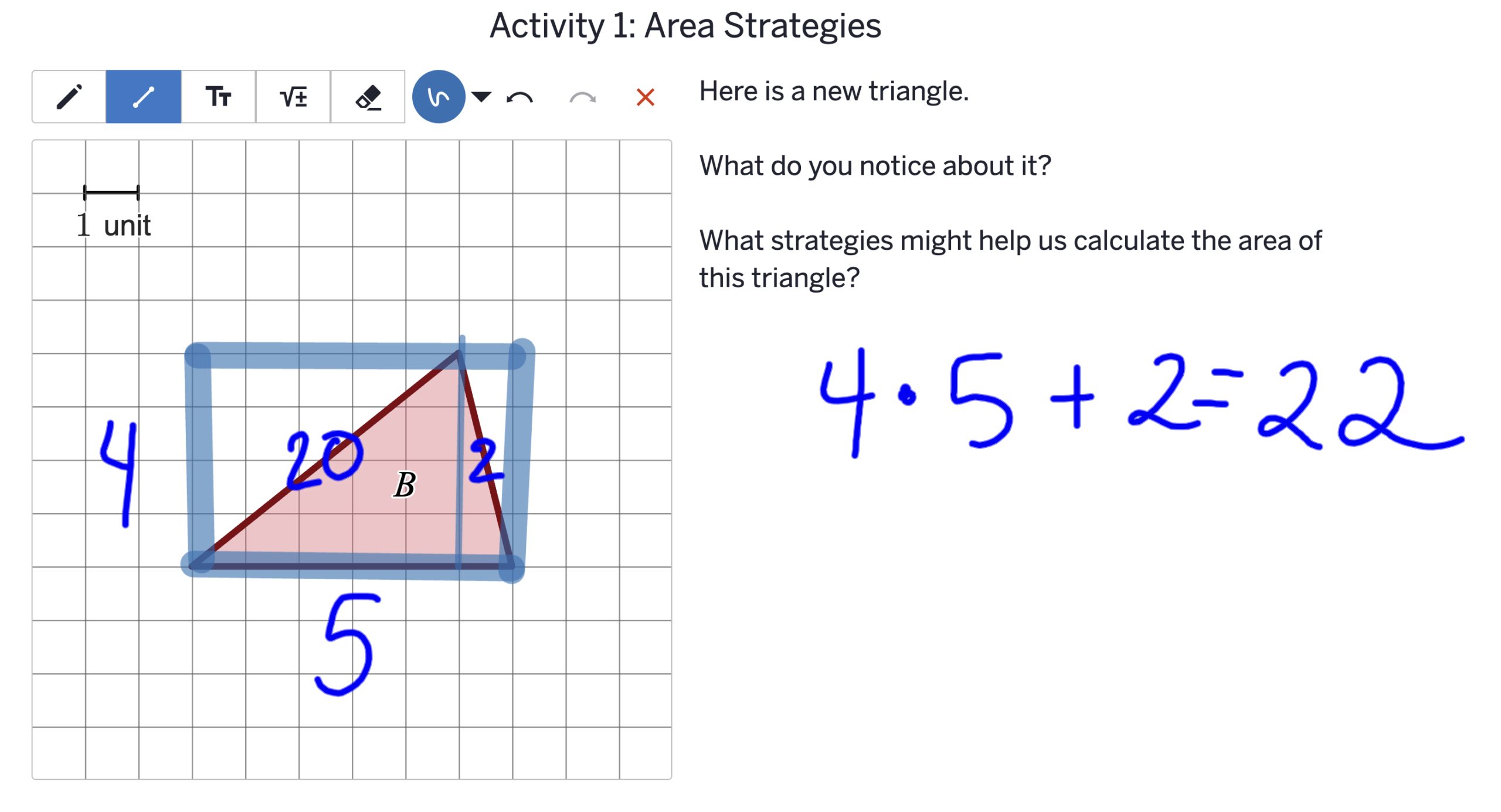
Unfortunately, we had determined earlier that Triangle B did not have an area of 22. Vivienne quickly revised her thinking: the triangular portion on the left did not have an area of 20: the rectangle surrounding it did! Vivienne had forgotten to find the area of ½ of the rectangle. So the left side of Triangle B was actually 10, and then the right side was… 1?
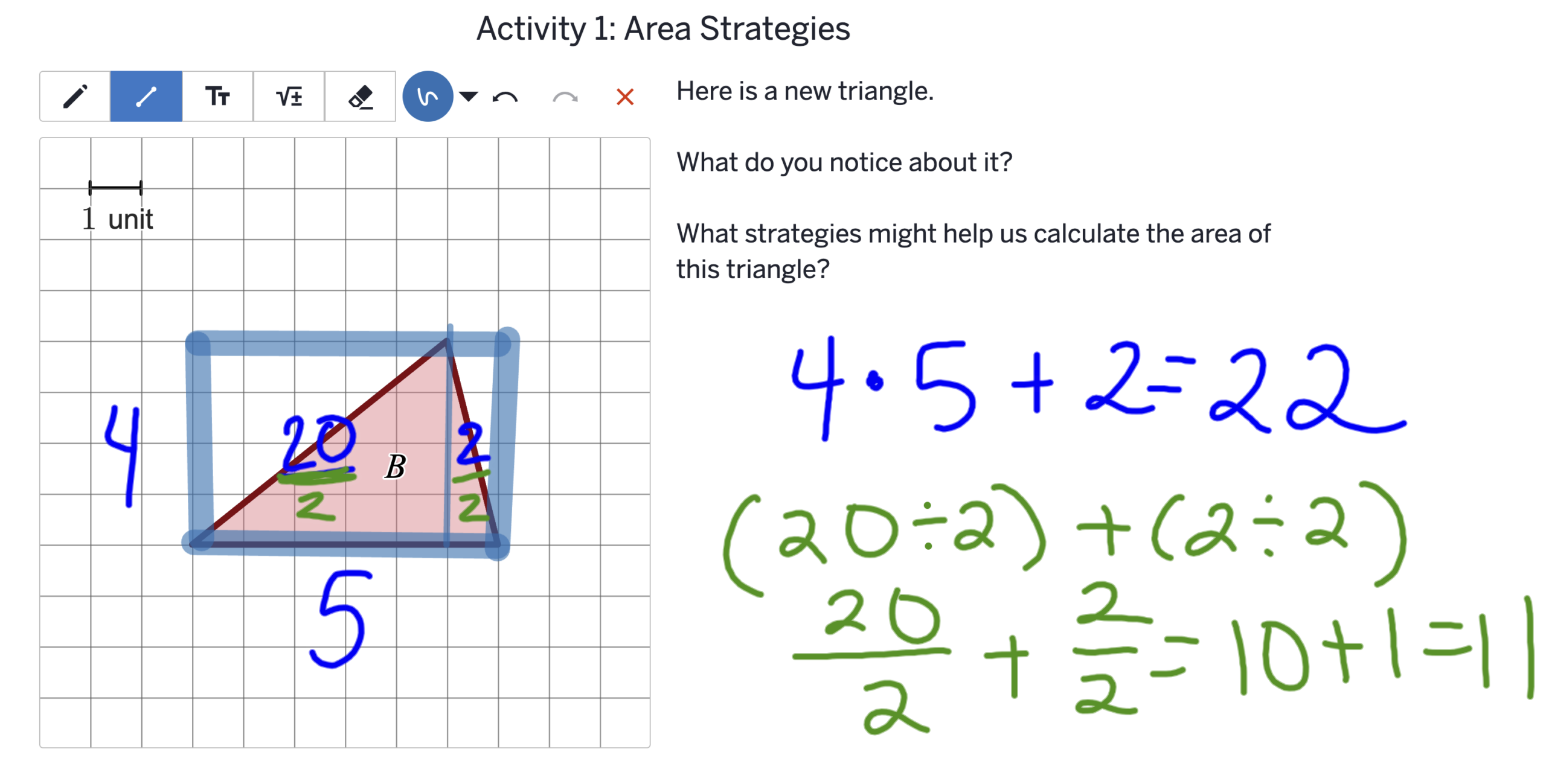
“But the triangle has an area of 12,” Charlie reminded us.
Vivienne seemed knotted up. I asked her classmates to turn and talk with the person next to them, devising a way to untangle what Vivienne did. There was so much right about it — so much brilliant thinking about the relationships of shapes and angles! — and yet she’d arrived at an area of 11 square units when we knew it was actually an area of 12. I made certain to praise Viv’s process, assigning genuine competence, knowing that it’s hard to have a mistake examined in front of a room full of middle school peers.
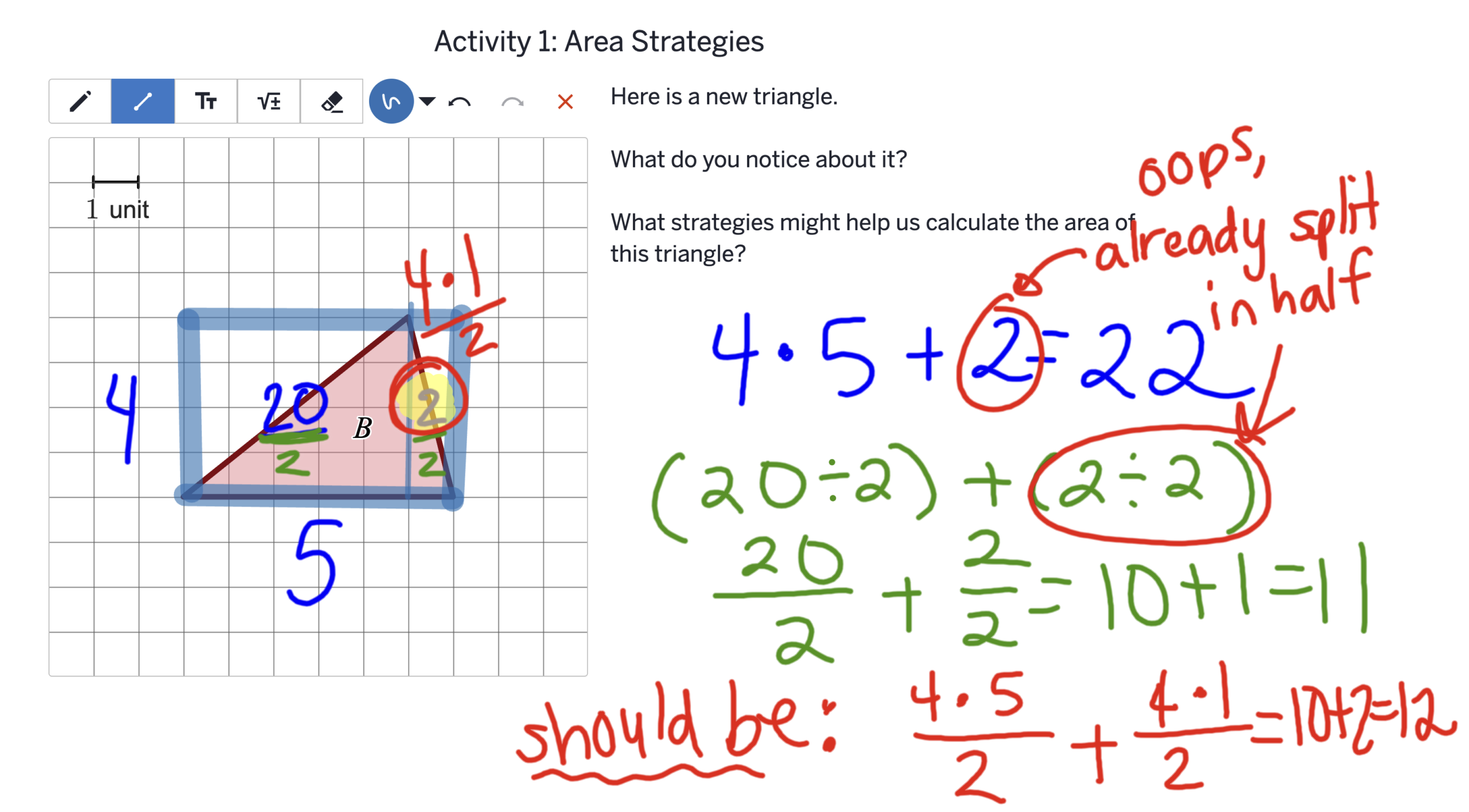
The class worked together to revise it. The 2 on the right was already the triangle’s area, half of a 4-by-1 rectangle, so dividing it by 2 again halved it twice.
(4 • 5)/2 + (4 • 1)/2 = 10 + 2 = 12
I asked students to share what they noticed and wondered about how I recorded the equation. Damian pointed out that it’s easier to see what is getting divided by 2 when we write the division in fraction form. That might help us make certain that we aren’t accidentally dividing one side but not the other. Once this format becomes familiar, the fraction notation actually helps with executive function! For this sixth grade problem, it was important to revise the answer, and not the question.
Which question do we answer?
In Vivienne’s case, we held onto the original question. Meanwhile, Grace rewrote the entire narrative. When do we correct the answer, and when do we correct the problem?
Both Grace and Vivienne had strategies grounded in strong mathematical ideas, and both needed a way to catch their own mistakes.
It comes down to the goals I have for a student. I want Vivienne to be able to find the area of triangles using her strategy, so we needed an accurate model for how to do that. I want Grace to be able to use derived facts and inverse operations to solve addition and subtraction within 20, and so the specific question was less important than the thinking. For Grace, the question she answered was the one that mattered.